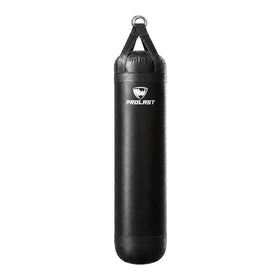
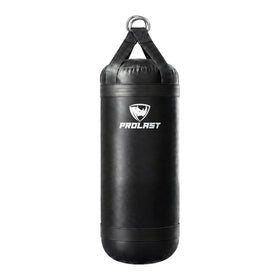
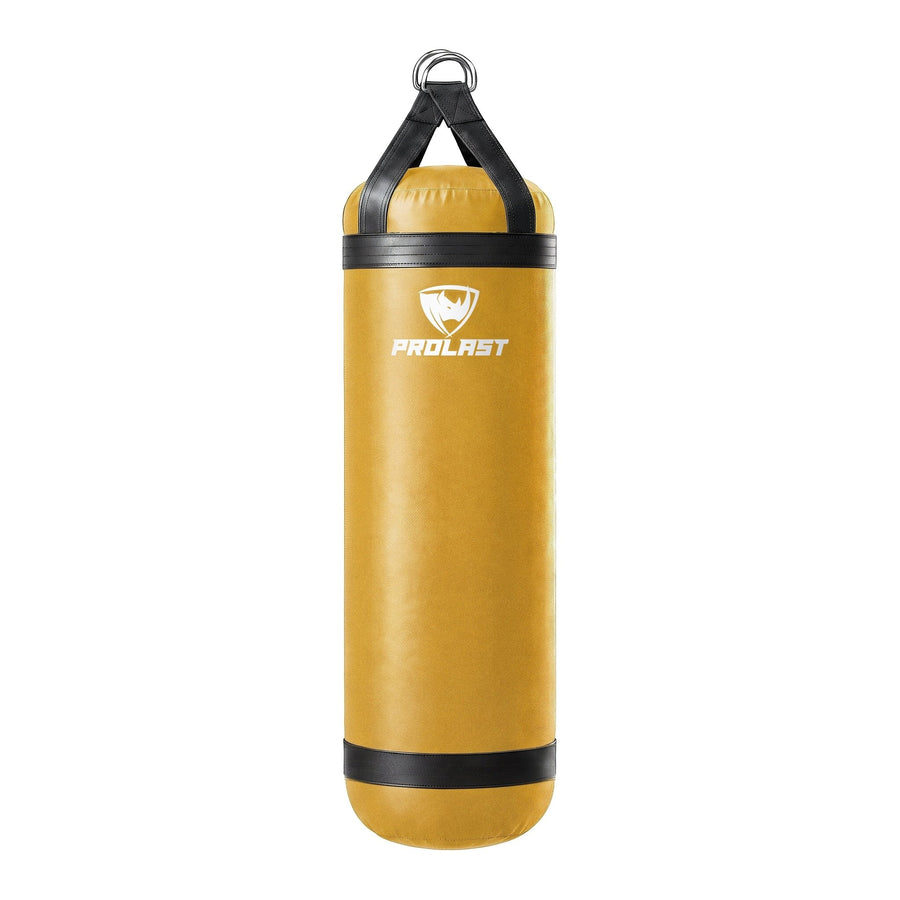
What size and weight heavy bag should you buy? 4, 5 or 6 ft, 80 to 300 lb
In short
Our heavy bags weigh 80 lb to 300 lb filled: 4 ft bags 80, 135 or 150 lb, 5 ft bags 100 or 200 lb, 6 ft bags 150 or 300 lb. A common starting point is a bag around half your body weight. Pick the height for what you train (4 ft punching, 5 ft body shots, 6 ft kicks and knees), then standard or XL for width and weight.

Our heavy bags weigh from 80 lb to 300 lb filled, depending on their size: 4 ft bags weigh 80, 135 or 150 lb, 5 ft bags 100 or 200 lb, and 6 ft bags 150 or 300 lb. We make all seven stock sizes in our factory in Whittier, California. They differ in two ways: height, which decides how much of the bag you can hit from top to bottom, and width, standard or XL. Here is every size, what each one weighs, how heavy yours should be, and how to choose.
Every size at a glance
| Size | Body height | Across | Around | Filled weight |
|---|---|---|---|---|
| 4 ft | 48 in | 14 in | 44 in | 80 lb |
| 4 ft XL | 48 in | 18 in | 56.5 in | 135 lb |
| 4 ft XL, four-panel | 48 in | 18 in | 56.5 in | 150 lb |
| 5 ft | 60 in | 14 in | 44 in | 100 lb |
| 5 ft XL | 60 in | 18 in | 56.5 in | 200 lb |
| 6 ft | 72 in | 14 in | 44 in | 150 lb |
| 6 ft XL | 72 in | 20 in | 62.8 in | 300 lb |
Heights are the bag body, without the straps.
How much does a punching bag weigh?
A heavy bag's weight comes from its size and its fill. Ours, filled:
| Height | Standard (14 in across) | XL (18 to 20 in across) |
|---|---|---|
| 4 ft | 80 lb | 135 lb, or 150 lb in the four-panel XL |
| 5 ft | 100 lb | 200 lb |
| 6 ft | 150 lb | 300 lb |
At the same height, an XL bag is wider and much heavier: the 6 ft XL is twice the weight of the standard 6 ft. Filled bags arrive at the weight in their name; unfilled bags arrive as an empty shell, and their weight is whatever you fill them with.
How heavy should your heavy bag be?
A common starting point is a bag around half your body weight, then heavier if you hit hard or kick, lighter if you want more movement. As a general guide, here is where that lands in our range:
| Your body weight | About half | Our bags around that weight |
|---|---|---|
| Up to 160 lb | Up to 80 lb | 4 ft 80 lb, our lightest |
| 160 to 220 lb | 80 to 110 lb | 4 ft 80 lb or 5 ft 100 lb |
| 220 to 280 lb | 110 to 140 lb | 4 ft XL 135 lb |
| 280 lb and above | 140 lb and up | 4 ft XL 150 lb, 6 ft 150 lb, 5 ft XL 200 lb or 6 ft XL 300 lb |
Then check the height: if you kick, you'll want a 6 ft bag whatever the weight, and if two people share the bag, size it for the heavier one.
Heavier or lighter: what changes
| Heavier bag | Lighter bag | |
|---|---|---|
| Swing | Moves less when you hit it | Swings more, so you move with it |
| Feel | Firmer, for power shots and kicks | Softer, quicker work and footwork |
| Hanging | Needs a mount or stand rated for it | Easier to hang, more mounts suit it |
70 lb or 100 lb?
As a general guide, a 100 lb bag swings less and suits heavier hitters and kicks, while a 70 lb bag suits lighter people and faster, lighter work. Our lightest bag is the 4 ft at 80 lb, and our 5 ft is 100 lb.
Height: 4, 5 or 6 ft
Height decides how much of the bag you can hit, from the top of it to the bottom.

4 ft (48 in)
The shortest bags, for boxing work: straight punches, hooks and combinations.
5 ft (60 in)
More bag below the waist, so body shots and lower punches land on the bag too.
6 ft (72 in)
The longest bags reach lowest, which leaves room for kicks and knees as well as punches.
Width: standard or XL
Standard bags are 14 in across. XL bags are 18 in across, or 20 in for the 6 ft XL, so there is more bag to hit and more weight at the same height: the 4 ft XL weighs 135 or 150 lb, the 4 ft 80 lb. The 4 ft XL 150 lb is the same size as the 4 ft XL 135 lb, built from four vertical panels.

Filled or unfilled
Every stock size comes either way. Filled bags arrive at the weight in their name, packed with shredded cotton fabric; take some out if you want the bag softer. Unfilled bags arrive as an empty shell for you to fill.

Hanging it
Each bag hangs from its straps on chrome D-rings. An optional bottom D-ring lets you tie the bag down for less swing on uppercuts, body shots and knee strikes.

Every stock bag up to the 5 ft XL 200 lb is within our ceiling mount's 250 lb rating; the 6 ft XL 300 lb needs the wall mount or a stand. Our guide on how to hang a heavy bag matches each size to the right mount and hardware.
Quick picks
| If you mostly | Look at |
|---|---|
| Punch and box | 4 ft or 4 ft XL |
| Want body shots too | 5 ft or 5 ft XL |
| Kick and knee | 6 ft or 6 ft XL |
| Want less swing | An XL size, or the bottom D-ring |
Colors and your logo
Every stock size comes in eight colors: black, red, blue, black and gold, brown, yellow, green and smoke grey. Every size is also available as a custom heavy bag in your colors with your logo.

What every stock bag has
- Made in our own factory in Whittier, California
- A 22 oz rip-stop vinyl-coated polyester shell
- Shredded cotton fabric fill on filled bags
- Chrome D-rings and reinforced straps and seams
- A lifetime warranty
- Free shipping in the contiguous US
Example bags
- 4 ft 80 lb heavy bag, our smallest.
- 4 ft XL 150 lb heavy bag, the four-panel XL.
- 5 ft XL 200 lb heavy bag.
- 6 ft XL 300 lb heavy bag, our largest.
Frequently asked questions
How much does a punching bag weigh?
It depends on the size and fill. Ours weigh from 80 lb (4 ft) to 300 lb (6 ft XL) filled: 4 ft bags 80, 135 or 150 lb, 5 ft bags 100 or 200 lb, and 6 ft bags 150 or 300 lb.
How heavy should my heavy bag be?
A common starting point is around half your body weight, heavier if you hit hard or kick. Our stock bags run from 80 lb to 300 lb filled.
How heavy is a 4 ft punching bag?
Our 4 ft bags weigh 80 lb standard, or 135 lb and 150 lb in XL, filled. All three are 48 in tall.
How much does a 6 ft heavy bag weigh?
Our 6 ft bag weighs 150 lb, and the 6 ft XL 300 lb, filled.
Should I get a 70 lb or 100 lb bag?
As a general guide, 100 lb swings less and suits heavier hitters and kicks; 70 lb suits lighter people and faster work. Our 4 ft is 80 lb and our 5 ft 100 lb.
What size heavy bag should I get?
Pick the height for what you train: 4 ft for punching, 5 ft to add body shots, 6 ft for kicks and knees. Then choose standard or XL for width and weight.
What is the difference between a 4 ft and a 4 ft XL bag?
Both are 48 in tall. The 4 ft is 14 in across and 80 lb; the 4 ft XL is 18 in across and 135 or 150 lb.
Which heavy bag is best for kicks?
A 6 ft bag reaches lowest, so it leaves room for kicks and knees. We make it in 150 lb and, as the XL, 300 lb.
Can I make a heavy bag softer?
Yes. Filled bags are packed with shredded cotton fabric; take some out to soften the bag.
Do the bags come filled?
Each stock size comes filled or unfilled. Filled bags arrive at the weight in their name.
Can I hang a 300 lb bag from a ceiling mount?
Not from ours: it is rated to 250 lb. Use the wall mount, rated to 500 lb, or a stand.
Products in this guide
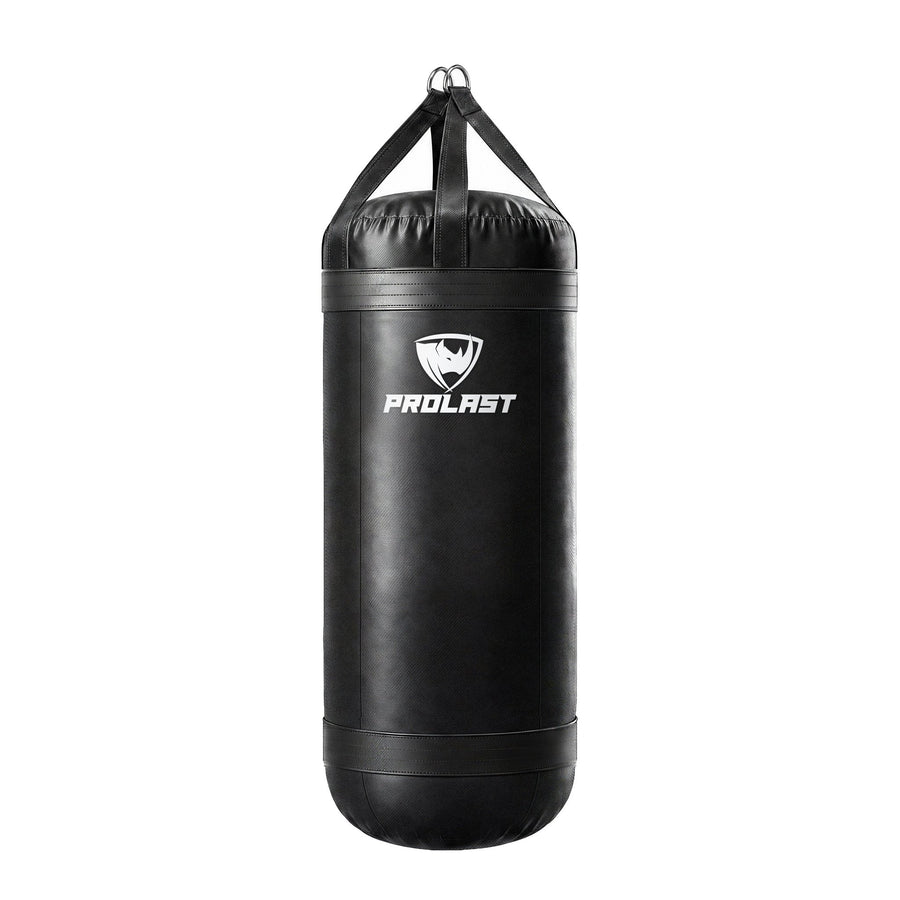


Heavy bags, stands and mounts
More guides
All guides from Guides Heavy bags · October 18, 2026
What to fill a punching bag with (and how to fill one)
Fill a punching bag with shredded fabric or textile scraps, packed tight in layers: it gives an even, cushioned feel, and it is what we fill...
6 min read Heavy bags · October 14, 2026
Teardrop, angle or wrecking ball: which heavy bag shape?
We make three shaped heavy bags: the angle uppercut bag (36 in tall, built around uppercuts), the teardrop (44 in, for hooks, uppercuts, clinch work and...
3 min read Heavy bags · October 13, 2026
How to hang a heavy bag: ceiling, wall or stand
Hang a heavy bag from a wood ceiling joist with a ceiling mount (holds 250 lb), from wood studs or a filled masonry wall with a...
5 min read